Blog
- Home
- Blog
- Hydraulic Pump
- Fixed vs Variable Displacement Pump: Where the Energy Savings Really Come From

 By
/ November 13, 2026
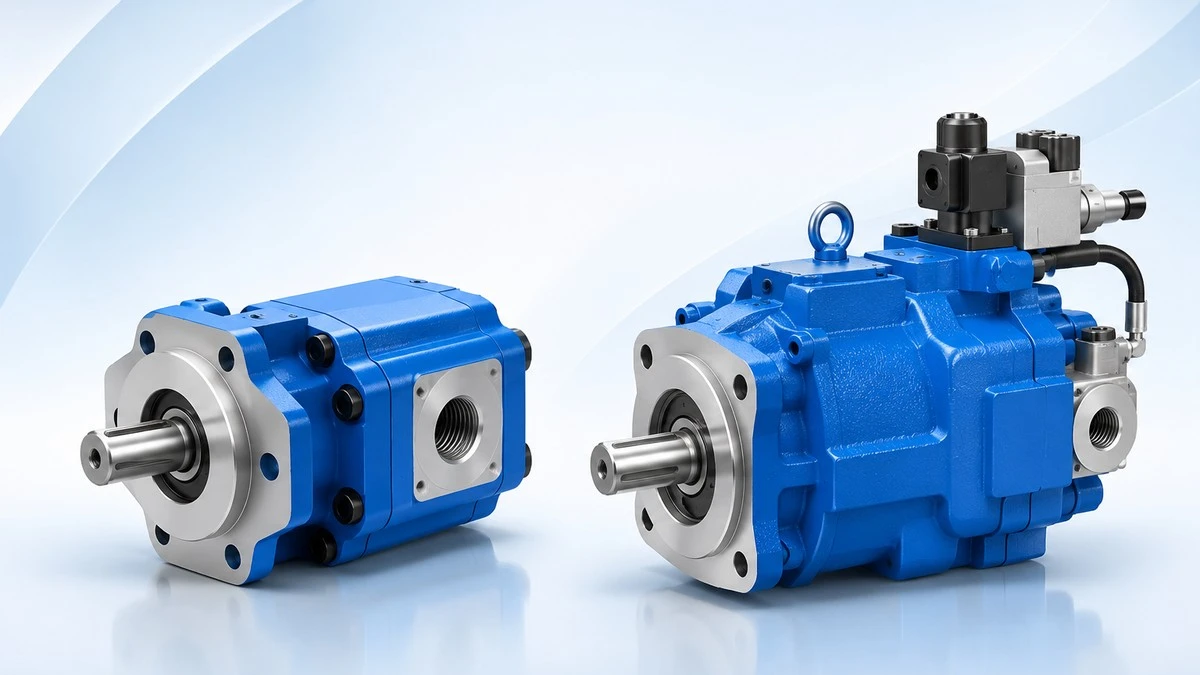
Variable displacement pumps are often recommended as the energy-efficient option for hydraulic systems, and in many cases that is true. But the saving is not automatic. It depends on how your machine actually works through the day.
A variable displacement pump saves energy only when the machine needs less flow than the pump can deliver. Presses that hold pressure, machine tools that clamp and wait, and plant systems that idle between cycles can waste a surprising amount of power with a fixed pump. A machine that runs at full flow and full pressure most of the time, on the other hand, may gain very little from switching.
In this article we look at the fixed vs variable displacement pump choice in practical terms: how each pump behaves, where a fixed pump loses power as heat, what the different variable pump controls do, and how you can estimate the saving on your own machine using a pressure gauge, the pump’s flow rating and a stopwatch.
Displacement is the volume of oil a pump moves in one revolution, normally stated in cc/rev. Multiply it by shaft speed and you get the pump’s theoretical flow.
A fixed displacement pump moves the same volume of oil on every revolution. With the electric motor running at constant speed, it delivers constant flow whether the machine needs it or not. Hydraulic gear pumps, fixed vane pumps and fixed piston pumps all work this way.
A variable displacement pump can change the volume it moves per revolution while it is running. In an axial piston pump, this is done by changing the swash plate angle. In a variable vane pump, the cam ring shifts to change the size of the pumping chambers. A control mounted on the pump decides how much flow to deliver, based on pressure, a load signal, an electrical command or input power.
| Fixed displacement pump | Variable displacement pump | |
|---|---|---|
| Flow at constant motor speed | Always the same | Adjusts to demand |
| What happens to unused flow | Returns to tank, usually over a relief valve or through an unloading circuit | Is never produced |
| Common types | Gear, fixed vane, fixed piston | Variable axial piston, variable vane, some radial piston |
| Purchase cost | Lower | Higher |
| Tolerance to dirty oil | Gear pumps are generally the most forgiving | Piston pumps and their controls need cleaner oil |
| Best suited to | Simple circuits, steady demand, short duty | Changing demand, long holding periods, multiple actuators |
For energy, the second row is what matters. A fixed pump always produces its full flow, so any oil the machine does not use still has to go somewhere. Where it goes, and at what pressure, decides how much power is wasted.
Hydraulic power is pressure multiplied by flow. In the units commonly used in Indian plants:
Power (kW) = Pressure (bar) × Flow (L/min) ÷ 600
Any oil that leaves the pump at high pressure and returns to tank without doing useful work turns into heat. That heat then has to be removed by an oil cooling system, so you pay for the same energy twice. In a typical fixed pump circuit, the losses come from three situations.
This is usually the biggest loss. While a press holds tonnage, a clamp stays closed or a machine waits for the next cycle, the actuators need almost no oil. A fixed pump keeps delivering full flow regardless, and unless the circuit unloads it, that oil goes over the relief valve at full system pressure.
Consider a fixed pump delivering 40 L/min with the relief valve set at 160 bar.
If the machine holds pressure for 60% of its running time and operates 4,800 hours a year (two shifts, 300 days), the difference is roughly 10.2 kW × 0.6 × 4,800 ≈ 29,000 kWh a year, before counting the extra cooling load. Multiply that by your electricity tariff to see the cost in rupees. These are illustrative figures rather than a guarantee, but the calculation is exactly the one you would use on a real machine.
When an actuator moves slowly, a flow control or proportional valve throttles the oil. With a fixed pump, the extra flow still goes over the relief valve at full setting. A basic pressure-compensated pump stops producing the extra flow, but it still holds its full compensator pressure. If the load needs only 50 bar and the compensator is set at 160 bar, around 110 bar is lost across the valve, and that pressure drop also turns into heat.
This is why a pressure-compensated pump is not always the most efficient option, and why load sensing control was developed.
When the machine genuinely needs full flow at full pressure, fixed and variable pumps do the same job and neither wastes much. A variable pump can even be marginally less efficient here, because its control adds a small loss. If your machine runs at full demand most of the time, a variable pump will not make a big difference.
The saving, then, comes from the hours your machine spends holding, waiting or moving slowly. Those are the hours worth measuring first.
Two variable displacement pumps of the same size can give very different energy results depending on the control fitted to them. When comparing quotations, check the control code as carefully as the displacement.
This is the most widely used control. The pump stays at full displacement until system pressure reaches the compensator setting, then reduces its output to hold that pressure. It delivers the large savings described above during holding and waiting, which is why it is the standard choice for presses, clamping circuits and machine tools. Its limitation is partial-load operation at low pressure, where the full compensator pressure is still dropped across the valves.
The system relief valve should be set a little above the compensator setting so that it acts only as a safety device. If the two settings are too close, the relief valve can open during normal running, wasting energy and causing heat and vibration.
A load sensing control reads the pressure on the load side of the directional valve and keeps the pump just slightly above it, typically by 10 to 30 bar. The pump supplies only the flow the actuators are using, at only a little more pressure than the load requires. With all valves in neutral, it idles at a low standby pressure. This avoids the main losses of both a fixed pump and a basic compensator, which is why load sensing is common on mobile machines and multi-function industrial circuits.
A power limiting control reduces displacement as pressure rises, so the pump never demands more power than the electric motor can deliver. It does not save energy directly, but it often allows a smaller motor, because the machine can have high flow at low pressure and high pressure at low flow without needing a motor sized for both at the same time. Presses with a fast approach stroke and a slow pressing stroke are a typical application.
With electro-proportional control, a PLC or controller sets the pump’s flow or pressure electronically through a proportional valve. This allows different pressures and speeds for each step of a machine cycle and suits automated equipment well. It costs more and needs clean oil and careful setup, but on machines with complex, changing cycles it can reduce throttling losses further.
Variable displacement is most common in axial piston pumps and variable vane pumps. Pressure-compensated vane pumps are a cost-effective option for moderate pressures on machine tools and presses, while piston pumps handle higher pressures and offer the full range of controls. You can compare both on our variable displacement pumps page.
A variable pump is not always the right investment. A fixed displacement pump often makes more sense when:
If you prefer to keep a fixed pump, there are proven ways to stop oil being wasted over the relief valve:
You do not need a data logger for a useful first estimate. A pressure gauge, the pump’s flow rating and a stopwatch are enough.
If most of the loss falls in holding and idle phases, a pressure-compensated pump or an unloading circuit will recover most of it. If much of it comes from slow movement at low pressure, load sensing or electro-proportional control is worth considering.
A simple cross-check: if your oil runs hot and the cooler works hard all day, a large share of your pump power is probably going over a relief valve. Our guide to hydraulic system overheating explains how to trace where that heat comes from.
With these details, a supplier can recommend the right pump and control rather than simply matching the old part number. For a wider view of pump selection, read our article on how to choose the right hydraulic pump for your application.
No. It saves energy when the machine needs less than full flow for a meaningful share of its running time, particularly while holding pressure or idling. On machines that run at full flow and full pressure most of the time, the saving can be small.
Often it can, but check the mounting flange, shaft, ports, drive motor and available space first. The circuit may need changes too. The relief valve must be set in coordination with the compensator, and circuits that depend on a fixed pump’s constant flow may behave differently.
No. A pressure-compensated pump holds a set pressure and reduces flow once that pressure is reached. A load sensing pump follows the actual load pressure and stays only slightly above it, which reduces losses when the load needs much less than the maximum pressure.
If much of your heat comes from oil flowing over the relief valve, then yes, usually by a noticeable amount. Less heat also means less work for the oil cooler and slower ageing of the oil.
It depends on the application. A variable speed drive can save a lot of energy where demand changes slowly. In circuits with rapid pressure changes, a pump compensator responds faster, so many designers choose a variable pump or combine both approaches.