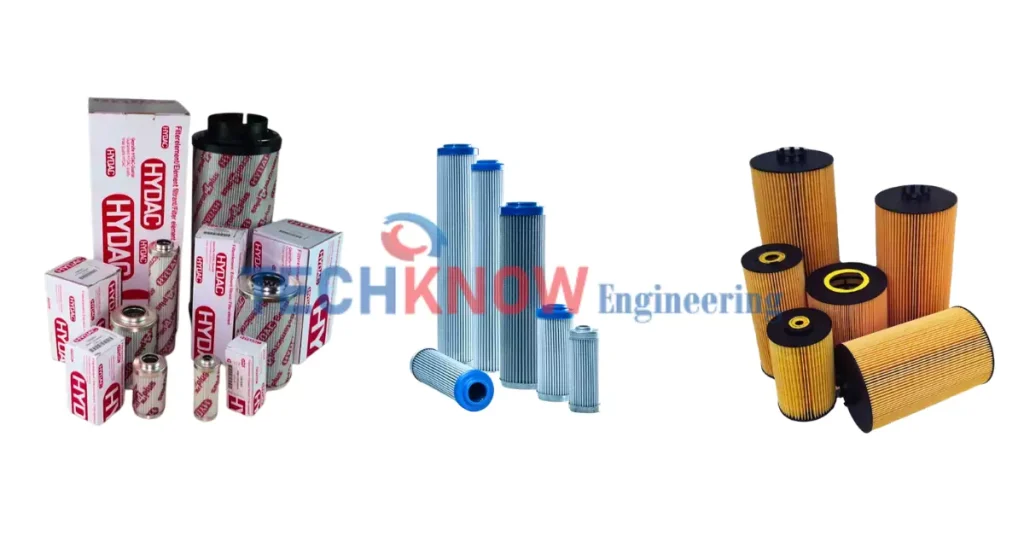

A filter element comes out of the housing covered in oil, the printing has worn away, and nobody recorded the part number when it was last changed. The machine is down. This is one of the most common calls a hydraulic supplier gets, and it is entirely solvable — usually in a few minutes.
Start with the code, if you have any of it
If you can read even part of the number you are most of the way there, because HYDAC element codes are self-describing. Take 0160 D 010 BN4HC:
0160 is the element size — the physical dimension family, which dictates whether it fits your housing.
D is the series. D is a pressure filter element, R is return line, and DN and RN are the equivalents built to DIN 24550 dimensions. This letter tells you where in the circuit the element belongs.
010 is the filtration rating in microns. Elements in this media are commonly 3, 5, 10 and 20 micron.
BN4HC is the media and construction. This is the part people overlook, and it matters most.
Why the media code is the one to get right
BN4HC is Betamicron glass-fibre media with a differential pressure rating of 17 bar (290 psid). BH4HC is the high-collapse version, rated to 210 bar (3045 psid).
Those two codes look almost identical on a worn label and describe elements with a twelvefold difference in collapse strength. Fit a BN4HC where a BH4HC belongs, let it load up with contamination, and the element collapses — sending every particle it had captured straight downstream into the pump, the valves and the cylinder seals. The filter becomes the source of a contamination event rather than the protection against it.
Other media codes you will meet: ON and W denote wire mesh or paper, which are nominal rather than absolute and used in low-pressure duty. Water-absorbing elements use a super-absorber that gels the free water in the fluid. Stat-Free construction addresses electrostatic discharge, which became a real concern with modern zinc-free and low-conductivity oils — these can generate enough static to ignite vapour inside a filter housing, so if your existing element is a Stat-Free type, the replacement must be too.
Beta ratio, briefly
The same element carries a beta rating. For a 10 micron BN4HC, β at 9.9 µm = 200 and β at 12.4 µm = 1000, which corresponds to 99.9% efficiency at the larger size.
Beta 1000 means that for every 1,000 particles of that size entering, one passes through. This is why “10 micron” alone is not a specification. Two elements both marked 10 micron can perform very differently depending on whether that rating is absolute or nominal, and at what beta value it was measured. When someone offers you a cheaper element that is “the same micron rating,” this is the question to ask.
When there is no readable code at all
Work through these in order. Each one alone may be enough.
Check the housing, not the element. The filter housing nameplate carries its own model number, and the correct element for that housing is fixed by design. This is the fastest route and the step most often skipped.
Check the machine documentation. OEM spare parts lists and hydraulic schematics usually specify filter elements by part number. The schematic will also confirm the circuit position, which gives you the series letter.
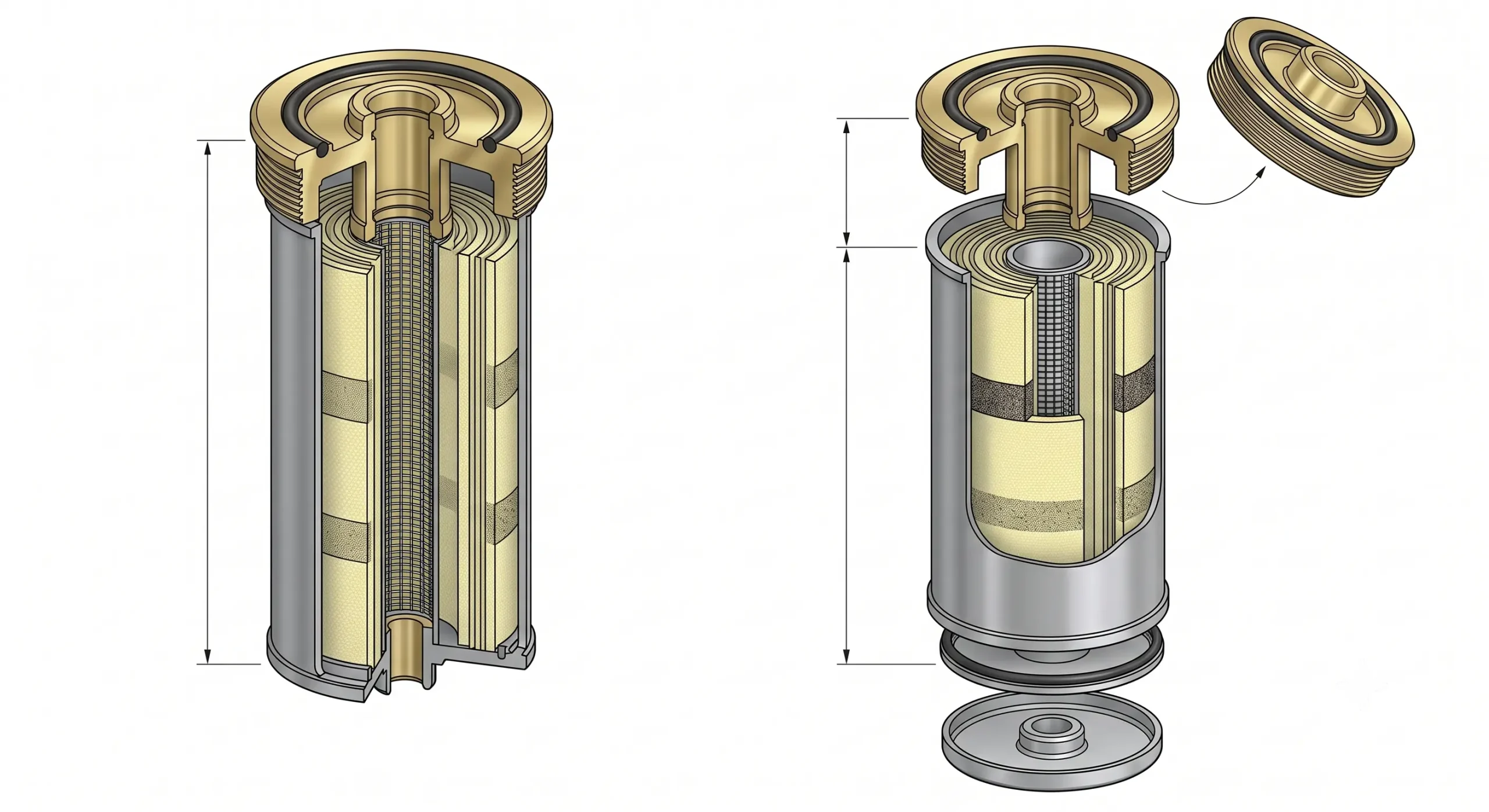
Measure the old element. Four dimensions do most of the work: outside diameter, inside diameter at the top, overall length, and the end cap arrangement. For reference, a 0160D010BN4HC measures roughly 2.72 in OD × 1.35 in ID × 4.53 in long. Note whether the end caps are open both ends, closed one end, or have a spigot, and whether there is a seal or O-ring in the cap — element families are distinguished by exactly these features.
Photograph it before it goes in the bin. Both ends, the side, and anything legible. A photograph plus four measurements is usually enough to identify an element.
Note the circuit position and pressure. Pressure line, return line, suction or off-line changes both the series and the collapse rating you need. If you know the working pressure at that point, say so.
What to send your supplier
The fastest identification comes from giving all of it at once: any part of the old code, the housing model number, the four measurements, photographs of both end caps, the circuit position, and the system’s working pressure. With that, a hydraulic filter element can normally be matched the same day.
One thing worth stating plainly: an interchangeable element is not a lower specification. A properly cross-referenced element matches form, fit and function — dimensions, media, beta rating and collapse pressure — and fits your existing housing without modification. What you should not accept is a match on micron rating alone, with the media code and collapse pressure treated as details. Those are the specification.
Before you refit the new element
If the old element came out collapsed, distorted or heavily loaded well before its expected change interval, the element was a symptom rather than the cause. Something upstream is generating contamination faster than the filter can handle, or the element was the wrong specification for the duty. Fitting an identical replacement will get you the same failure on the same timescale.
Three things are worth doing before you close the housing.
Fit a clogging indicator if there isn’t one, so you are changing elements when differential pressure actually rises rather than on a calendar.
Establish what the fluid is actually carrying. Oil cleanliness testing to ISO 4406 tells you whether the oil is inside the target class for your equipment — servo and proportional valves need a far cleaner class than a simple gear pump circuit — and whether the system needs flushing before any element will last. This is on-site work, so the machine does not have to come apart for it. Without that measurement you are changing elements without knowing whether the filtration is the problem at all.
And check what the contamination has already reached. Particles that get past a collapsed element score cylinder bores and wreck rod seals, and that damage shows up later as external leakage and drift rather than as a filter problem. If a cylinder on the same circuit has started weeping or losing position, hydraulic cylinder service and repair will tell you whether the bore is still serviceable — reseal and honing is usually far cheaper than replacement if it is caught early.
FAQs
Can I identify an element from dimensions alone?
Often yes, for the physical fit. But dimensions do not tell you the media or collapse pressure, so pair the measurements with the circuit position and system pressure.
Will a non-OEM element void my machine warranty?
Generally not, provided the element meets the OEM specification for filtration rating, beta value and collapse pressure. Keep the documentation showing equivalence. If the machine is inside a warranty period with specific terms, check those terms.
What is the difference between absolute and nominal micron ratings?
An absolute rating is tied to a measured beta value and is repeatable. A nominal rating is an approximation with no defined efficiency behind it. Wire mesh and paper elements are typically nominal; glass-fibre depth media is rated absolute.
How long should a filter element last?
There is no fixed interval — it depends on contamination ingress, duty cycle and fluid condition. Differential pressure is the meaningful signal, which is what a clogging indicator measures.
My elements keep failing early. What should I check first?
Confirm the element specification matches the duty, particularly the collapse rating, then measure the actual fluid cleanliness. Repeat early failures almost always mean either the wrong element or a contamination source the filter was never sized to handle.