
When a pump fails, the pump usually gets replaced and the investigation stops there. A few thousand hours later the replacement fails the same way, and by then nobody connects the two events.
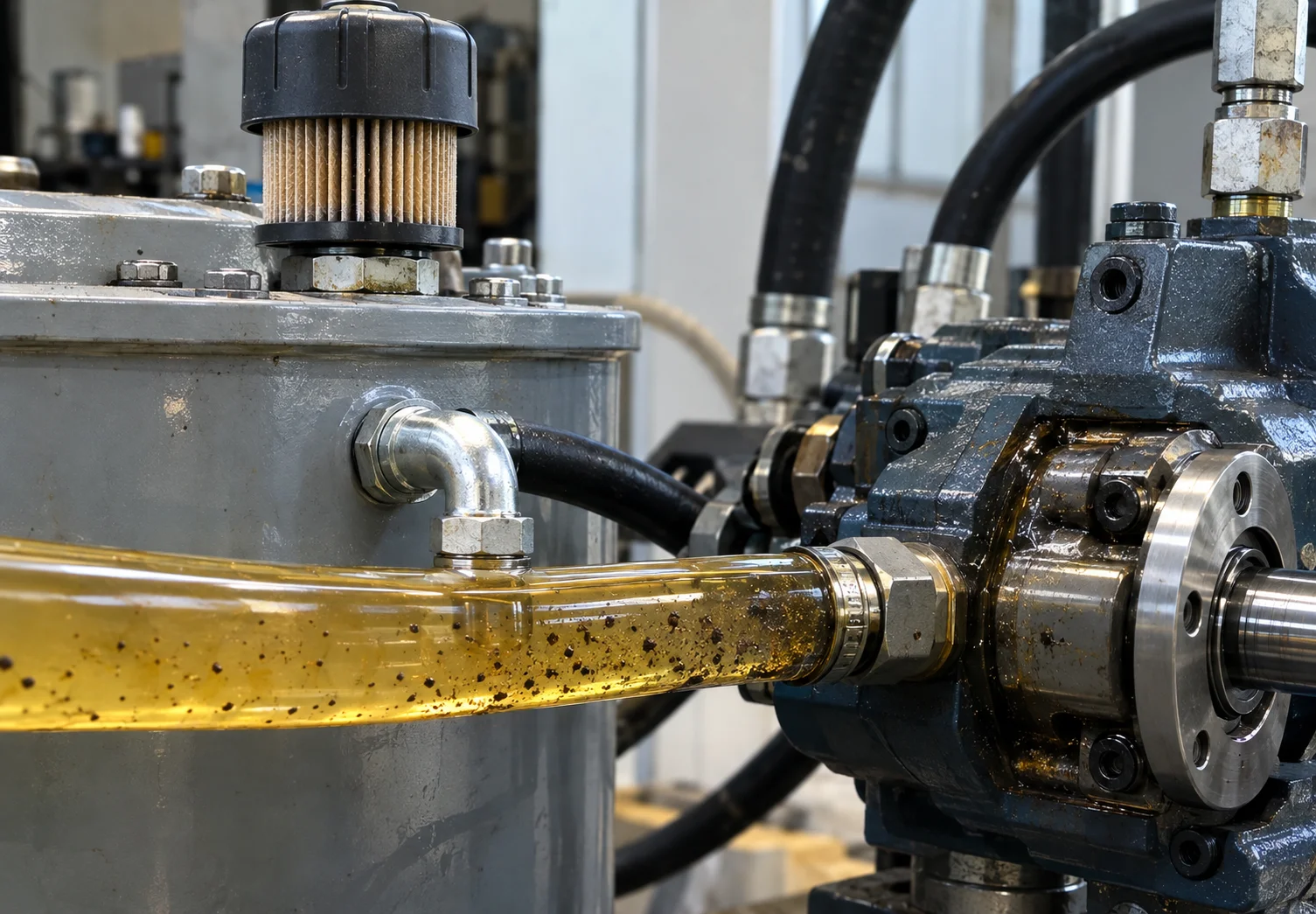
Hydraulic oil contamination is behind a large share of those failures, and the reason it goes unrecognised is simple: the particles doing the damage are invisible. The human eye resolves down to roughly 40 microns. The particles that destroy pumps are a fraction of that size. Oil that looks perfectly clean in a sample bottle can be well outside the cleanliness class your pump needs.
The clearances are smaller than the dirt
This is the whole argument in one table. Published contamination guidance puts typical critical running clearances at:
| Component | Typical critical clearance |
|---|---|
| Gear pump | 0.5 – 5 µm |
| Vane pump | 0.5 – 5 µm |
| Piston pump | 0.5 – 1 µm |
| Servo valve spool | 1 – 4 µm |
A piston pump running at 0.5 to 1 micron clearance is operating with tolerances finer than most people picture. Particles in that same size range are exactly the ones that enter the clearance, get trapped, and grind. Larger particles mostly cannot get in; much smaller ones pass straight through. It is the silt-sized fraction that does the work.
That is why a pump can be destroyed by contamination its operator never saw, and why “the oil looked fine” is not an assessment.
The chain reaction nobody interrupts
Here is the part that matters most.
A particle enters a clearance and scrapes metal from the surface. That scraped metal becomes two or three new particles, each in the same damaging size range. Those circulate and generate more. The published term for this is the chain reaction of wear, and it is self-accelerating: contamination generates wear, and wear generates contamination.
The practical consequence is that a contamination event does not end when the source is removed. If a pump has been running dirty for months, the oil now carries the system’s own wear debris, and fitting a new pump into that oil starts the clock on the next failure immediately. Replacing the pump without cleaning the fluid is replacing the symptom.
Where the particles actually come from
Four routes, roughly in order of how often they turn out to be the real culprit.
The reservoir breather
The tank is not sealed. As cylinders extend and retract the oil level moves, and the tank draws ambient air in to compensate. In a cement plant, foundry or construction site, that air is loaded with dust. A vented cap or an undersized breather quietly makes the reservoir the dirtiest part of a circuit people otherwise filter carefully. Matching the breather rating to the system’s cleanliness target is one of the cheapest reliability improvements available.
Cylinder rod seals
A rod extends into the environment, picks up dust and moisture on the wet film of oil, and the wiper drags some of it back in on retraction. Worn wipers make this considerably worse, and a cylinder that has started weeping externally is usually ingesting in both directions.
New oil
This one surprises people. New hydraulic oil straight from the drum is frequently dirtier than the target class for the system it is going into, because it collects contamination in handling, storage and transfer. Filtering oil on the way in, rather than trusting the drum, is standard practice in plants that take cleanliness seriously.
Maintenance work itself
Open a reservoir on a dusty shop floor, use a lint-shedding rag, leave a hose end uncapped on the bench, and you have introduced more contamination in ten minutes than the breather manages in a month.
What “clean enough” actually means
ISO 4406 reports contamination as a three-number code counting particles larger than 4, 6 and 14 microns per millilitre, for example 18/16/13. Each one-point increase in a code number roughly doubles the particle count at that size, so the gap between 18/16/13 and 20/18/15 is not a modest deterioration. It is four times the particles.
Commonly published targets by component:
| System type | Typical ISO 4406 target |
|---|---|
| Servo and proportional valves | 16/14/11 or cleaner |
| Axial piston pumps | 17/15/12 |
| Piston and vane pumps | 18/16/13 |
| Gear pumps, lower pressure | 19/17/14 |
The target is set by the most sensitive component in the circuit, not the average one. A system running gear pumps alongside a single servo valve has to hold the servo valve’s target.
One note on the figure you will see quoted everywhere, that 70 to 80 percent of hydraulic failures are caused by contamination. It is cited widely across the industry, though the original basis for it is rarely given. Treat it as directionally right rather than a precise number. The mechanism is well established even if the percentage is not.
Breaking the chain
If a pump has failed and contamination is suspected, the sequence that actually works is this.
Measure before you replace. Oil cleanliness testing to ISO 4406 tells you whether the fluid is inside the target class for your equipment. Without that number you are guessing at whether filtration is the problem at all. It is on-site work, so the machine does not have to come apart for it.
Find the ingress route. Check the breather filter rating against the system target, inspect the cylinder wipers, and ask how oil is actually transferred into the reservoir.
Clean the fluid, not just the filter. If the oil is badly out of class, a new element will load quickly and you are back where you started. Offline or kidney-loop filtration brings the system back to target before the new pump goes in.
Check what the debris has already reached. Particles that got past a collapsed element score cylinder bores and wreck rod seals, and that damage shows up later as external leakage and drift rather than as a filter problem. If a cylinder on the same circuit has started weeping or losing position, hydraulic cylinder service and repair will tell you whether the bore is still serviceable. Honing and resealing is usually far cheaper than replacement when it is caught early.
Verify after. Re-test the fluid once the system has run for a while. A cleanliness programme without measurement before and after is just a belief.
FAQs :-
Can I tell if oil is contaminated by looking at it?
No. Particles below about 40 microns are invisible, and those are precisely the ones that damage pump clearances. Clear, bright oil can be several ISO codes outside target. Particle counting is the only valid assessment.
My oil looks dark. Is that contamination?
Darkening usually indicates oxidation or thermal degradation rather than particulate contamination, though the two often travel together. Both are worth investigating, but they are different problems with different fixes.
Is a finer filter always better?
Not automatically. An over-fine element in the wrong position increases pressure drop and can load prematurely. The filtration rating should be matched to the component target and the circuit position, which is why pressure, return and suction filters carry different ratings.
How often should oil cleanliness be tested?
It depends on how critical and how dirty the environment is. A baseline at commissioning, then periodic trending, is more useful than a single reading. The trend tells you more than the number.
Will changing the filter fix a contaminated system?
Only if the contamination level is close to target. Badly contaminated oil needs cleaning up with offline filtration first, or the new element simply loads and the problem returns.