
Hydraulic accumulators are the silent workhorses of industrial systems. They store energy, stabilize pressure, absorb shocks, and keep your machinery running smoothly often without anyone noticing. Until something goes wrong.
The problem? Accumulator failures rarely happen overnight. They build up slowly through wear, gas loss, bladder fatigue, and seal degradation. By the time a visible breakdown occurs, the damage – and the downtime – is already expensive.
The good news: your system almost always gives you warning signs before a complete failure. Knowing what to look for can save you thousands in repairs, prevent unplanned shutdowns, and extend the life of your hydraulic equipment.
In this guide, the expert team at Techknow Engineering Enterprise shares the 7 most critical warning signs that your hydraulic accumulator needs immediate attention.
What Does a Hydraulic Accumulator Actually Do?
Before diving into the warning signs, it helps to understand what an accumulator is supposed to do.
A hydraulic accumulator stores pressurized hydraulic fluid using a compressed gas charge (typically nitrogen). It releases this stored energy when the system demands it – helping to:
- Maintain system pressure during peak demand
- Absorb pressure spikes and pulsations
- Act as an emergency power source
- Reduce pump cycling and energy consumption
- Compensate for minor fluid leakages
Whether it’s a bladder accumulator, diaphragm accumulator, or piston accumulator, the core function is the same: store energy, release it when needed, protect the system.
When any part of this mechanism starts to fail, your entire hydraulic circuit is affected.
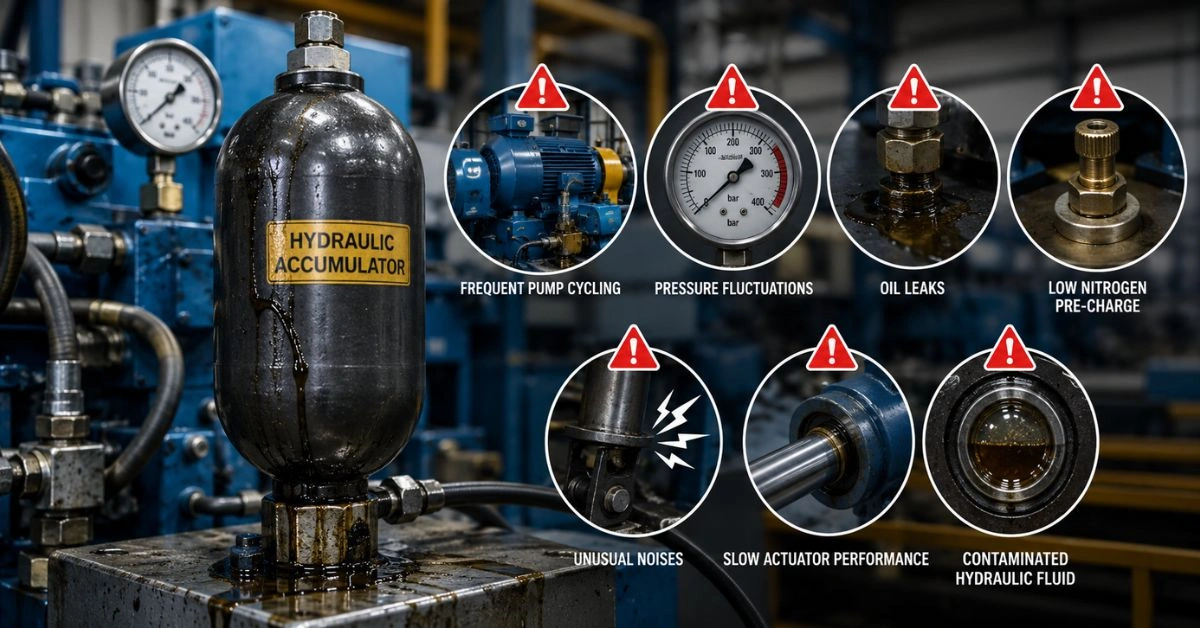
Warning Sign #1: Frequent or Rapid Pump Cycling
What it looks like: Your hydraulic pump is turning on and off more often than usual, or it seems to run almost continuously.
What it means: One of the primary jobs of an accumulator is to store enough pressurized fluid so the pump doesn’t have to work non-stop. When the accumulator loses its nitrogen pre-charge – or the bladder/diaphragm is damaged – it can no longer store energy effectively.
The result? Your pump picks up the slack, cycling far more frequently to maintain system pressure. This puts enormous strain on the pump motor, increases energy consumption, and accelerates wear across the entire system.
Why act immediately: Ignoring this sign doesn’t just damage the accumulator – it will eventually burn out your pump as well, turning a small repair into a major one.
Warning Sign #2: Pressure Fluctuations and Instability
What it looks like: Pressure gauges showing erratic readings, pressure dropping suddenly during operation, or the system struggling to maintain consistent pressure under normal load.
What it means: A healthy accumulator acts as a pressure buffer – smoothing out spikes and dips to keep the hydraulic circuit stable. When the accumulator is failing, this buffering function breaks down.
You may notice:
- Jerky or uneven movement in hydraulic cylinders
- Inconsistent speed of actuators
- Pressure gauge needles fluctuating noticeably
This is a particularly dangerous sign in precision applications – such as steel rolling mills, injection molding machines, or hydraulic presses – where pressure consistency is critical to product quality.
Why act immediately: Unstable pressure doesn’t just reduce performance. It puts mechanical stress on valves, seals, and fittings throughout the circuit, leading to cascading failures.
Warning Sign #3: Visible Hydraulic Oil Leaks Around the Accumulator
What it looks like: Oil staining, wet patches, or puddles of hydraulic fluid near the accumulator body, end caps, or connection ports.
What it means: External leaks around an accumulator typically point to deteriorating seals, O-rings, or end cap gaskets. Over time, heat, pressure cycling, and chemical degradation cause these seals to harden, crack, and lose their ability to contain fluid.
In bladder accumulators, a rupture in the bladder itself can allow hydraulic oil to pass into the gas chamber – which is a serious internal failure, not just a surface leak.
Why act immediately: Oil leaks are not just a maintenance inconvenience. They create slipping hazards on the shop floor, indicate internal component failure, and signal that the accumulator can no longer hold its rated pressure. Operating a leaking accumulator is a safety risk.
Warning Sign #4: Loss of Nitrogen Pre-Charge Pressure
What it looks like: During routine pre-charge checks, you find the nitrogen pressure is significantly below the recommended level – or the gas charge has dropped to zero.
What it means: Every accumulator operates with a specific nitrogen pre-charge pressure set during installation. This gas pressure is what allows the accumulator to compress and store hydraulic fluid effectively.
Pre-charge loss can occur due to:
- A damaged or worn gas valve (Schrader valve)
- Micro-perforations in the bladder or diaphragm
- Failed gas-side seals in piston accumulators
- Gradual nitrogen permeation through the bladder material over years of use
A deflated accumulator is essentially a dead accumulator – it cannot store or release energy and provides no benefit to the system.
Why act immediately: Running a system with a de-charged accumulator means the circuit has no pressure reserve. Any sudden demand spike – or emergency scenario – will find your system unprepared.
Tip: Techknow Engineering Enterprise recommends checking nitrogen pre-charge pressure every 6 months as part of routine preventive maintenance. Our team provides on-site accumulator charging services using calibrated charging kits.
Warning Sign #5: Unusual Noises – Knocking, Banging, or Water Hammer
What it looks like: Audible thumping, banging, or hammering sounds coming from the hydraulic circuit, especially during pressure transitions or when actuators change direction.
What it means: These sounds – commonly called “water hammer” or hydraulic shock – indicate that pressure pulses and fluid surges are traveling unchecked through the system. A properly functioning accumulator absorbs these shocks before they become audible.
When the accumulator loses its damping ability (due to gas loss or internal component failure), pressure waves hit valves, pipes, and fittings with full force, creating the characteristic knocking or banging sounds.
Why act immediately: Hydraulic shock is not just noisy it is destructive. Repeated pressure hammering causes fatigue cracking in pipes, loosens fittings, damages valve bodies, and can rupture hoses. Left unchecked, it leads to sudden and dangerous system failures.
Warning Sign #6: Bladder or Diaphragm Failure Indicators
What it looks like: Hydraulic oil appearing on the gas-side of the accumulator (detected during maintenance), nitrogen gas contaminating the hydraulic fluid, or the accumulator failing to hold pressure at all.
What it means: The bladder or diaphragm is the critical separating element inside the accumulator it keeps the hydraulic oil and nitrogen gas completely isolated. When this separator fails:
- Nitrogen can dissolve into the hydraulic oil, causing foaming and erratic system behavior
- Hydraulic oil enters the gas chamber, reducing the effective volume and destroying accumulator performance
- The accumulator may still appear to be working but provides dramatically reduced energy storage capacity
Bladder failures are typically caused by:
- Fluid incompatibility (wrong hydraulic oil type)
- Excessive temperature
- Over-pressurization events
- Age-related material fatigue (bladders typically last 5–10 years depending on operating conditions)
Why act immediately: A failed bladder cannot be repaired it must be replaced. However, the accumulator shell and fittings can often be reused with a fresh bladder kit, making timely replacement far more economical than replacement of the entire unit.
Tip: Techknow supplies OEM-compatible accumulator bladder and diaphragm spares for all major brands. Our service team can perform on-site bladder replacements with minimal downtime.
Warning Sign #7: Overheating of the Hydraulic System
What it looks like: Hydraulic oil temperature running higher than normal operating ranges, or the system consistently reaching thermal shutdown limits during standard operation.
What it means: While overheating has several possible causes, a failing accumulator is a commonly overlooked contributor. Here’s why:
When an accumulator cannot store and release energy efficiently, the hydraulic pump must work harder and run longer to compensate. Continuous pump operation generates heat. Additionally, rapid pressure cycling caused by a depleted gas charge creates heat through repeated fluid compression.
If you’ve checked your oil cooler and fluid levels and the overheating persists, the accumulator should be your next point of inspection.
Why act immediately: Hydraulic oil operating above its rated temperature threshold degrades rapidly, losing its viscosity and lubricating properties. This accelerates wear on every component the oil touches pumps, valves, cylinders, and seals. Overheating is one of the fastest ways to shorten the entire system’s service life.
How Often Should Hydraulic Accumulators Be Serviced?
As a general guideline, Techknow Engineering Enterprise recommends the following maintenance schedule:
| Maintenance Task | Recommended Frequency |
|---|---|
| Nitrogen pre-charge pressure check | Every 6 months |
| External inspection for leaks & corrosion | Every 3 months |
| Bladder / diaphragm condition inspection | Every 12 months |
| Full accumulator overhaul | Every 3–5 years (or per OEM schedule) |
| Safety valve and gas valve inspection | Every 12 months |
These intervals may vary based on operating pressure, temperature, duty cycle, and the specific application. High-duty industrial environments such as steel plants, power stations, or marine applications may require more frequent checks.
What Happens If You Ignore These Warning Signs?
The consequences of a neglected accumulator range from inefficiency to catastrophe:
- Unplanned downtime — A failed accumulator can bring an entire production line to a halt
- Secondary equipment damage — Pumps, valves, and cylinders suffer when the accumulator isn’t doing its job
- Safety hazards — Pressure vessel failures are dangerous. Accumulators operate under high pressure and must be maintained to safety standards
- Higher long-term costs — A timely bladder replacement costs a fraction of replacing a pump, cylinder, or damaged piping system
Techknow Engineering Enterprise: Your Accumulator Service Partner in Mumbai
With over 12 years of experience and 300+ service jobs completed, Techknow Engineering Enterprise is one of Mumbai’s most trusted names in hydraulic accumulator service and repair. As one of the leading hydraulic accumulator dealers in India, we supply, service, and repair all types of accumulators — bladder, diaphragm, and piston — for industries across the country and internationally.
Our services include:
- Accumulator pre-charge testing and recharging using calibrated nitrogen charging kits
- Bladder, diaphragm, and piston seal replacement using genuine OEM-compatible spares
- Full accumulator overhaul and certification
- On-site inspection and maintenance support across Mumbai and pan-India
- Supply of accumulator spares and accessories for all major brands
Whether you are looking for hydraulic accumulator dealers in India for new supply, urgent replacements, or scheduled maintenance, Techknow Engineering Enterprise offers fast response, competitive pricing, and genuine technical expertise backed by 12+ years in the field.
We service bladder accumulators, diaphragm accumulators, and piston accumulators across industries including steel, power, marine, automotive, cement, and oil & gas.
Don’t Wait for a Breakdown – Schedule a Service Today
If you’ve noticed any of the warning signs described in this article, don’t wait for a complete failure. Early intervention is always faster, safer, and more cost-effective.
Techknow Engineering Enterprise has been serving industries across India and internationally since 2012. We specialize in hydraulic accumulators, pumps, valves, cylinders, filtration systems, and oil cooling equipment – backed by certified engineering expertise and a commitment to zero-downtime solutions.
Contact us and our team will get back to you promptly.