

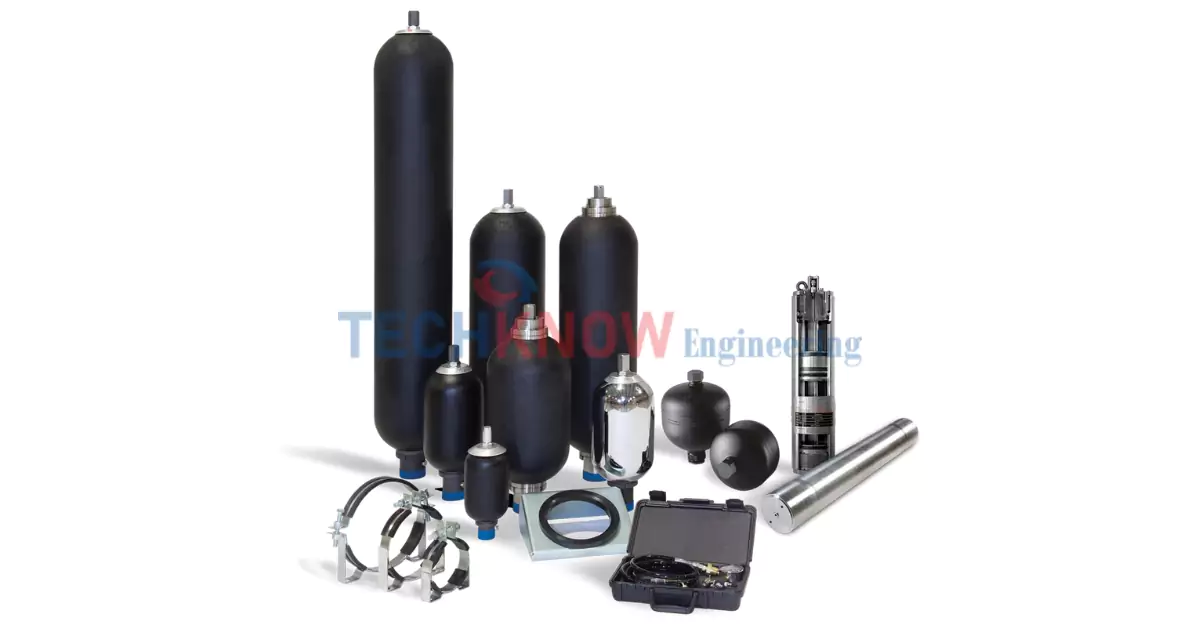
Hydraulic systems are the muscle behind much of modern industry, providing the force needed to lift, press, and move heavy loads. But even the strongest systems experience fluctuations. Pressure drops, shock waves from rapid valve closures and the need for emergency power reserves can all compromise performance. This is where Hydraulic Accumulators come in.
Think of an accumulator as a rechargeable battery, but for fluid power rather than electricity. These pressure vessels hold hydraulic fluid under pressure, stored by a compressible gas (usually nitrogen) or a spring. They smooth out pulsations, provide energy during peak demand, and maintain system pressure when the pump is off.
For professionals working with Techknow Engineering Enterprise, understanding the nuances of different accumulator types is essential for system efficiency and safety. Choosing the wrong component can lead to sluggish performance or even system failure. This guide breaks down the primary types of Hydraulic Accumulators and the essential accessories that keep them running.
Types of Hydraulic Accumulators
Bladder Accumulators
Bladder accumulators are perhaps the most versatile and widely used type in general hydraulic applications. The design is relatively simple: a seamless steel shell contains a flexible rubber bladder filled with nitrogen gas. When hydraulic fluid enters the shell, it compresses the bladder. When the system needs pressure, the gas expands, pushing the fluid back out.
Advantages
The primary benefit of a bladder unit is its rapid response time. Because there is very little inertia involved in expanding the rubber bladder, these units are excellent for absorbing shock and dampening pulsations. They are also generally tolerant of fluid contamination since the friction is minimal.
Disadvantages
However, they do have limitations. The bladder can be damaged if the compression ratio (the ratio of maximum to minimum pressure) is too high. Sudden failure of the bladder can release gas into the hydraulic system, which requires immediate maintenance.
Piston Accumulators
When you need to store a large volume of fluid or operate at very high pressures, the piston accumulator is usually the answer. This design features a sliding piston inside a cylinder that separates the gas from the fluid. It functions similarly to a hydraulic cylinder but without a rod.
Advantages
Piston Accumulators are incredibly robust. They can handle very high flow rates and extreme temperature variations that might degrade a rubber bladder. They also offer a much higher compression ratio, meaning they can utilize more of their total volume for fluid storage.
Disadvantages
The trade-off is response time. The mass of the piston and the friction of the seals mean these units react slower than bladder types, making them less effective for high-frequency shock absorption. Additionally, the seals will eventually wear out and require replacement to prevent fluid bypass.
Diaphragm Accumulators
For smaller systems where space and weight are critical factors, Diaphragm Accumulators are the standard choice. These units use a flexible disc (diaphragm) to separate the gas and fluid chambers. They are typically spherical or lens-shaped.
Advantages
These are lightweight, compact, and inexpensive. Like bladder accumulators, they have a very fast response time, making them ideal for managing pulsations in sensitive instrumentation or mobile equipment. They are practically maintenance-free until the diaphragm reaches the end of its life.
Disadvantages
The main drawback is size. Diaphragm accumulators have a limited volume capacity. They are not suitable for systems requiring significant energy storage for auxiliary power.
Essential Support Equipment
Selecting the pressure vessel is only half the battle. To integrate an accumulator into a system effectively, you need the right support infrastructure. Techknow Engineering Enterprise provides a range of specialized equipment to support these systems.
Accumulator Charging Kits
An accumulator is useless without the correct nitrogen pre-charge. Over time, gas can permeate through seals or bladders, reducing efficiency. A charging kit allows technicians to check, bleed, or increase the nitrogen pressure within the vessel. Regular checks using these kits are a non-negotiable part of maintenance.
Accumulator Spares
Every mechanical component has a lifespan. Having access to high-quality spares is vital for minimizing downtime. For bladder units, this usually means replacement bladders and anti-extrusion rings. For piston units, seal kits are the primary concern. Keeping these spares on hand ensures that a minor leak doesn’t turn into a major production halt.
Accumulator Accessories
Proper installation requires specific hardware. This includes safety blocks (which allow for isolation and pressure relief), sturdy mounting brackets to handle the weight and vibration of the unit, and adapters to fit various piping standards.
Accumulator Stations
Sometimes, a single unit isn’t enough. Accumulator stations (or banks) connect multiple vessels to a common manifold. This modular approach allows for massive energy storage capacity, essential for large presses or backup power systems that need to operate multiple actuators simultaneously.
High Pressure Booster Units
In some specialized applications, the available system pressure or gas bottle pressure isn’t high enough to achieve the required pre-charge. High-pressure booster units are used to intensify the gas pressure, ensuring the accumulator is charged to the exact specifications required for high-performance applications.
Common Applications Across Industries
You will find these components working silently in almost every heavy industry.
- Construction: In excavators and loaders, Hydraulic Accumulators act as shock absorbers (ride control), smoothing out the bumps as heavy machinery travels over rough terrain.
- Manufacturing: In injection molding and die casting, piston accumulators provide the sudden burst of high speed and pressure needed to fill molds instantly.
- Energy: In wind turbines, Hydraulic Accumulators provide the emergency power to pitch the blades to a safe position if the main power fails.
Maintenance and Safety
Hydraulic accumulators are pressure vessels. If mishandled, they can be dangerous. Safety is the top priority. Before performing any maintenance, the hydraulic pressure must be fully relieved from the fluid side.
Routine maintenance involves checking the nitrogen pre-charge pressure. If the pre-charge is too low, the bladder or piston may hit the bottom of the shell, causing damage. If it is too high, the accumulator won’t store enough fluid. Visual inspections for leaks and corrosion on the shell are also critical.
Optimizing Your Hydraulic System
Understanding the difference between a bladder, piston and diaphragm accumulator helps you make smarter decisions for your machinery. Whether you need the instant response of a bladder unit for shock absorption or the heavy-duty power of a piston unit for energy storage, the right choice leads to a smoother, longer-lasting system.
At Techknow Engineering Enterprise, we understand that the hardware is only as good as the support behind it. From selecting the right type of vessel to supplying charging kits, spares, and complete accumulator stations, ensuring your hydraulic energy is stored safely and efficiently is our priority.
Hydraulic Accumulator Types
Hydraulic accumulators are essential for energy storage in hydraulic systems. Learn about bladder, piston, and diaphragm types, their applications, and maintenance tips. Techknow Engineering provides charging kits, spares, and solutions to ensure your systems operate efficiently and reliably.
Product Currency: INR
Product In-Stock: InStock
5