
Shut the pump down, lock it off, and the hydraulic system is safe to work on. That assumption is correct for most circuits, and it is exactly wrong for any circuit with an accumulator on it.
A valve or cylinder loses its stored energy within minutes of the pump stopping. An accumulator does not. It holds its charge indefinitely, through a shift change, overnight, through a weekend shutdown, and it will release that energy the moment someone cracks a fitting. A standard lockout procedure isolates the energy source. It does nothing about the energy already stored in the vessel.
This is a known gap in hydraulic lockout practice, and it is the reason accumulators warrant their own procedure rather than being covered by the general machine LOTO.
Why the accumulator is a separate hazard class
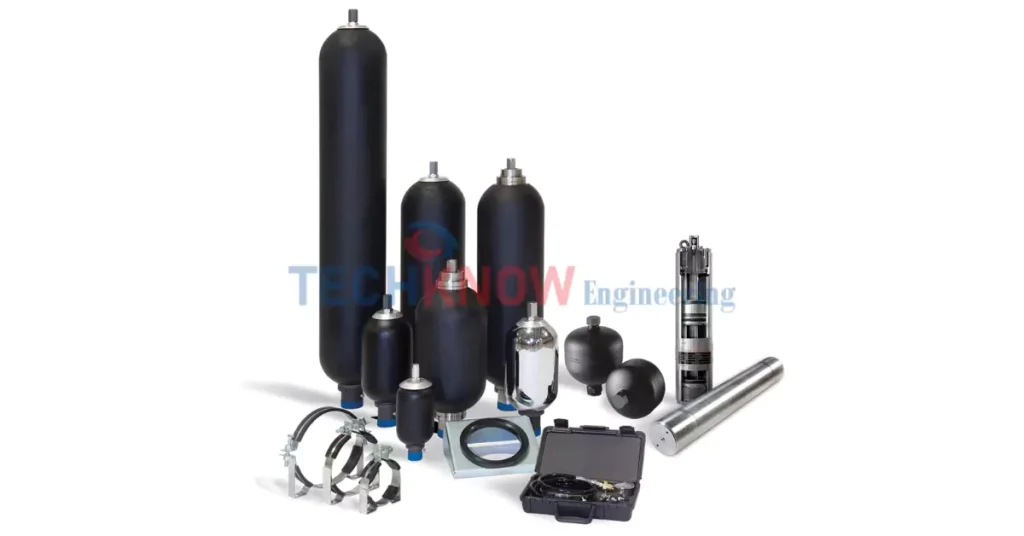
Think about what is actually in there. A 20 litre accumulator at 200 bar contains oil under pressure behind a gas charge that wants to push it out. Open a port and that oil leaves at pressure, through whatever gap is available, in whatever direction the gap faces.
Two injury mechanisms matter. The first is the obvious one: a sudden release of pressurised oil, or a fitting that becomes a projectile when the thread lets go. The second is fluid injection, where oil at pressure penetrates skin through a pinhole. It often looks trivial at first and is a genuine surgical emergency. Neither of these requires the pump to be running.
There is a third risk that is purely about the gas side. The nitrogen charge remains in the accumulator even after the oil has been fully drained. An accumulator that has been removed from a machine and is sitting in the workshop is still a pressure vessel. Welding, drilling, cutting or grinding on a charged shell is how people get killed, and it happens because the unit looked inert.
The equipment that makes this safe, and what to do without it
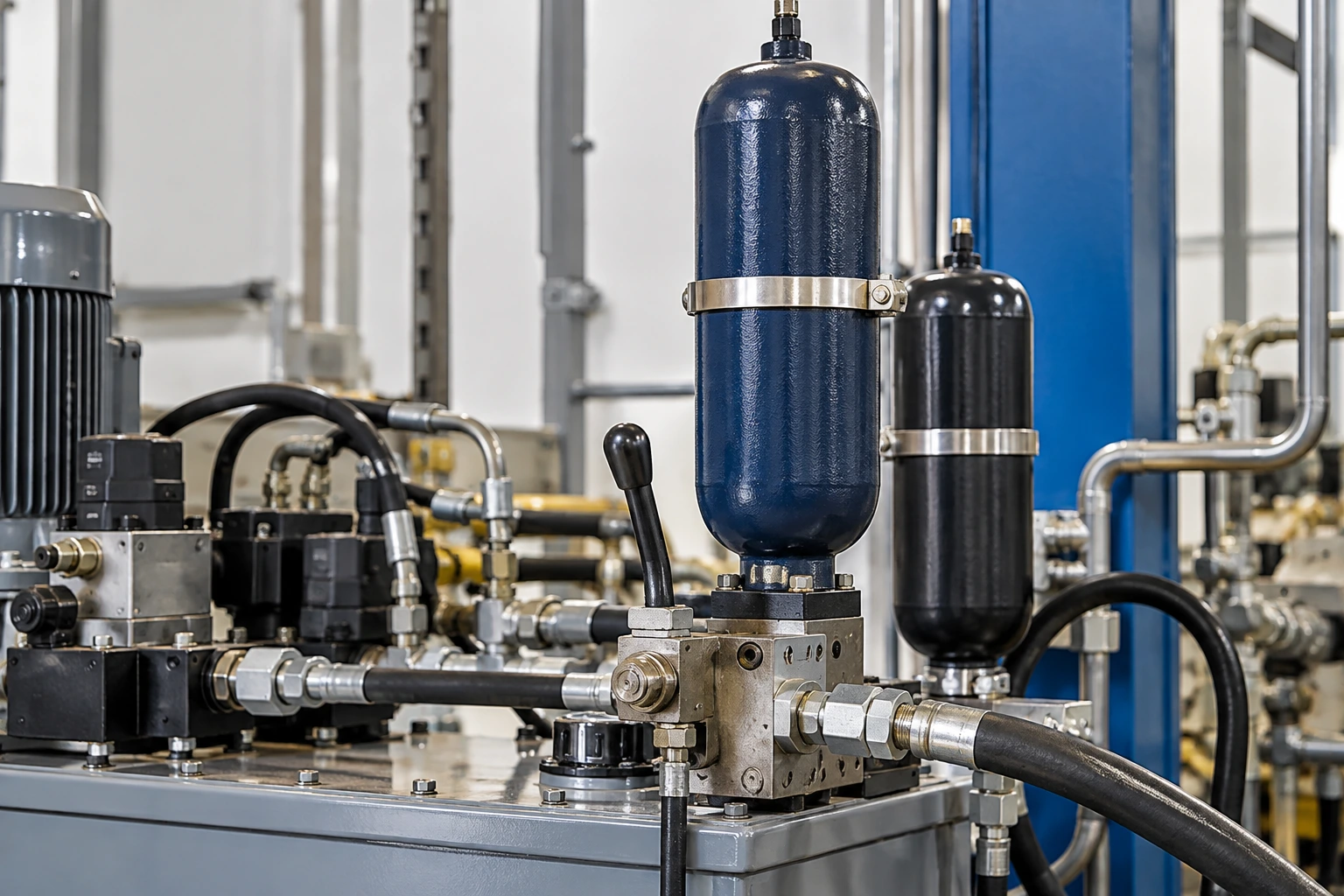
Every accumulator installation should have a shut-off and bleed block valve between the accumulator fluid port and the system pressure line. These combine an isolation valve with a manual bleed, usually with a gauge port, in a single assembly. Some designs include a pressure relief element as well.
The purpose is simple. It lets you separate the accumulator from the circuit and then release its stored oil in a controlled way, to tank, through a valve you are operating deliberately, rather than by loosening a connection and hoping.
If a machine has an accumulator and no isolation and bleed valve, that is the finding. Fitting one is straightforward and it should be done before any routine servicing regime is built around that unit. Where that work is combined with an inspection of the accumulator itself, our accumulator service and repair team can assess the installation and the unit at the same visit.
Working on an accumulator that cannot be isolated means discharging it through the circuit itself, which is possible but far less controlled, and it has to be verified with much more care.
The sequence
This is the general order. The machine’s own service manual takes precedence where it differs, and the manufacturer’s instructions for the specific accumulator take precedence over both.
Put on the protective equipment first. Safety glasses and chemical-resistant gloves at minimum. Oil under pressure does not announce itself.
Shut down the power unit using the normal stopping procedure and apply lockout to the electrical supply. This stops new energy entering the system. It does not empty the accumulator.
Release circuit pressure. Actuate a control valve or open a manual bleed point downstream so the accumulator discharges its oil back to tank through the circuit. On many machines this is the normal dump function and it does most of the work.
Close the accumulator isolation valve. The unit is now separated from the rest of the system.
Bleed the fluid side locally. Open the bleed valve on the block slowly. Have a container ready if the bleed does not return directly to tank. Slowly matters here — a fast release can throw oil and will not give you a reliable reading.
Verify zero on a gauge. This is the step that gets skipped, and it is the one that counts. Read the fluid-side pressure on a gauge you trust, and leave the bleed valve open while you do it. Tap the gauge bezel gently to confirm the needle is genuinely at rest rather than stuck. A gauge that has been in service for years and never been checked is not verification.
Only then approach the gas valve. Remove the gas guard and valve cap. If you are checking pre-charge, the fluid side must already be at zero, or the gauge reading will be system pressure rather than pre-charge and the number will be meaningless.
Leave the bleed valve open while work proceeds. Pressure can re-accumulate if a check valve passes or if someone restores power. An open bleed path is a continuous verification rather than a one-off check.
Don’t forget the loads the accumulator was holding
Stored energy is not only in the vessel. On machines where the accumulator supports a brake, a clamp or a raised load, discharging it can allow that load to move.
Before bleeding, check what the accumulator is holding up and block or lower it mechanically first. A cylinder that drifts under load is a related warning sign here, because drift means the cylinder is passing internally and cannot be relied on to hold position during the work. If that is the case on your machine, hydraulic cylinder service and repair should be scheduled alongside the accumulator work rather than treated as a separate problem for later.
What people get wrong
Trusting the lockout tag. A padlock on the isolator tells you no new energy is coming in. It says nothing about what is already stored. These are different things and the accumulator is specifically the component that makes them different.
Cracking a fitting to “check” pressure. This is how injection injuries happen. Loosening a connection to see whether oil comes out is not a test, it is the hazard. Use the bleed valve and a gauge.
Assuming a time delay is enough. Accumulators do not self-discharge in any useful timeframe. Waiting twenty minutes, or coming back in the morning, changes nothing at all.
Forgetting the second accumulator. Larger systems often have more than one, sometimes in a bank, sometimes one tucked away on a pilot or brake circuit a long way from the main manifold. Every accumulator on the machine has to be isolated and discharged, not just the obvious one.
Treating a removed accumulator as safe. The gas charge is still in there. It needs to be discharged through the gas valve before any cutting, welding, drilling or scrapping, and it should be stored and transported as the pressure vessel it still is.
If the accumulator has failed internally
A ruptured bladder or a failed piston seal changes the job. The gas side and fluid side are no longer separated, nitrogen can be driven into the hydraulic circuit, and elastomer debris goes downstream into valves and pumps.
In that situation, isolating and discharging the unit is only the first step. The fluid needs checking before the system goes back into production, because debris from a failed accumulator will not clear itself. Oil cleanliness testing to ISO 4406 establishes whether the oil is still inside the target class for your equipment or whether the system needs flushing first, and it is done on site rather than requiring the machine to come apart.
The accumulator itself can usually be rebuilt. Bladder, seals and gas valve replacement with pressure testing is considerably cheaper than a new unit, provided the shell is sound — our accumulator repair and recertification service covers the assessment and the documentation.
Before putting it back into service
Once the work is done the sequence reverses, with one addition. Close the bleed valve, open the isolation valve, remove the lockout and restart the power unit, then check the accumulator is actually performing. If the maintenance involved the gas side, re-check pre-charge after the unit has run and reached operating temperature, because nitrogen pressure moves with temperature and a reading taken cold will not match the working condition.
For plants with several accumulators to bring back into spec, on-site accumulator charging and testing avoids stripping units out of machines one at a time.
Build the procedure once
The most useful thing a plant can do is write the accumulator steps into the machine-specific lockout procedure rather than relying on the technician remembering. That means recording, for each machine: how many accumulators there are and where, where the isolation and bleed valves are, which gauge to read, and the specified pre-charge for each unit.
A procedure that names the location of every accumulator on the machine removes the single most common failure, which is the one nobody knew was there.
FAQs :-
Does lockout and tagout cover the accumulator?
Only if the procedure explicitly includes isolating and discharging it. Standard LOTO isolates the energy source. An accumulator retains stored energy after the source is isolated, so it needs its own steps within the procedure.
How long does an accumulator take to discharge on its own?
It does not. A healthy accumulator holds pressure indefinitely. Any discharge has to be done deliberately through a bleed path.
Can I check pre-charge without discharging the fluid side?
No. With hydraulic pressure still on the fluid side, the gauge reads system pressure rather than pre-charge, and the number is useless. The fluid side must be at verified zero first.
Is a removed accumulator safe to cut up or scrap?
Not until the gas charge has been released through the gas valve. A removed accumulator with nitrogen still in it is a pressure vessel, and cutting, drilling or welding on it is dangerous.
What if the machine has no isolation valve on the accumulator?
Discharge through the circuit using the normal dump function and verify zero on a gauge before touching anything. Then treat the missing valve as a defect to be corrected — every accumulator installation should have shut-off and bleed capability.
Who should be doing this work?
Anyone carrying out hydraulic maintenance on a machine with an accumulator needs specific training on stored-energy hazards, not just general hydraulic safety. The hazard is not intuitive, which is precisely why it causes injuries.